
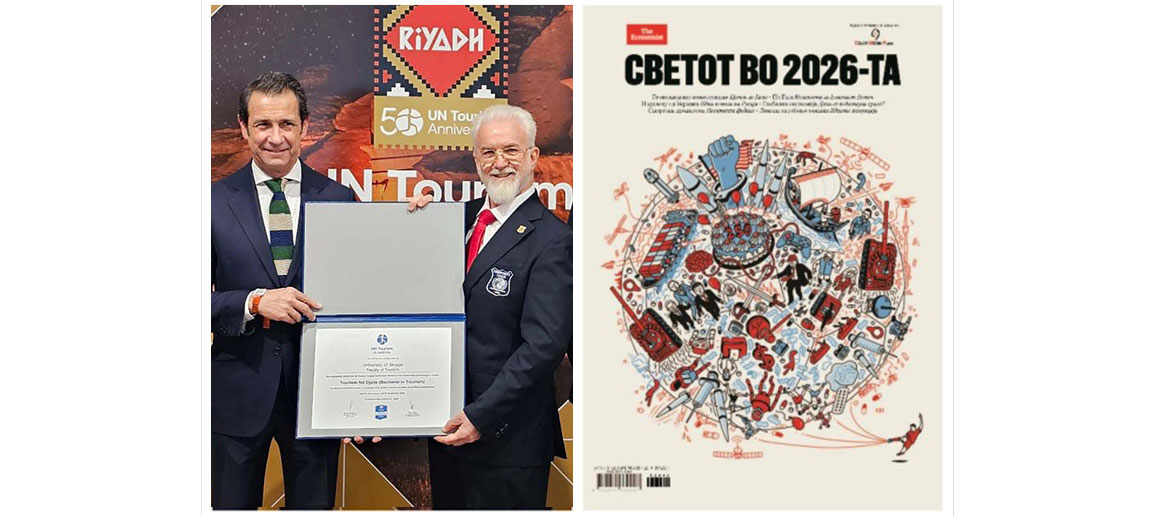
EXCLUSIVE INTERVIEW: “PERSONAL PRESENCE AT GLOBAL ASSEMBLIES AND CONTACTS WITH THE WORLD’S ELITE BRING US RECOGNITION AND GREATER SUCCESS”
Source: Beauty and HealthProf.
PhD. Ace Milenkovski, Rector of the University of Skopje, for The Economist: The World in 2026The 26th General Assembly of the United Nations World Tourism Organization (UN Tourism) was held in Riyadh, Saudi Arabia, from 7 to 11 November, as well as the 45th Plenary Session of the Associate Members of this organization.
At the same time, the 50th anniversary of this organization was celebrated.A delegation from the University of Skopje, which has been an associate member of UN Tourism since 2010, led by the Rector, Prof. PhD Ace Milenkovski, participated in this gathering of the world's elite in the field of tourism, among representatives of hundreds of countries or governments, representatives of business, science and education.On this occasion, the Director of Innovation, Education and Investment of UN Tourism, Antonio Lopez de Avila, awarded the certificate of quality for the Faculty of Tourism of the University of Skopje.
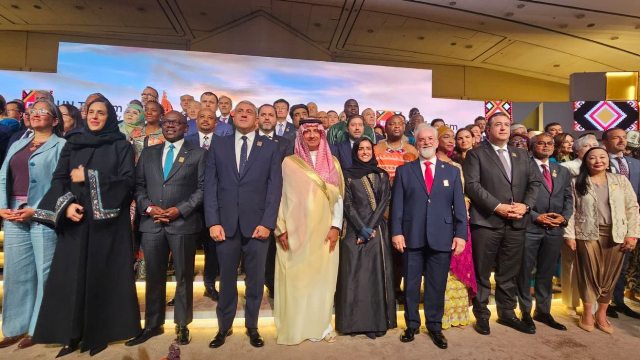
We talk to the Rector of the University of Skopje, Ace Milenkovski, about this great global gathering, its significance, the meetings that took place and personal impressions.
Rector Milenkovski, what is the significance of such a global event, under the auspices of the United Nations, and why is personal presence important?
The significance is enormous, because, first of all, it is a gathering of all those who matter in the field of tourism in the world, but not only in tourism, because the tourism industry is closely connected to many other activities, which significantly affect the overall economic and social development of countries.
Application of artificial intelligence, facilitation of travel through biometric data, infrastructure projects, new start-up companies, inclusion of science, as well as modern curricula in education. So, a whole range of activities are included. That is one aspect.
On the other hand, the motto of the United Nations World Tourism Organization is "Bringing the World Closer Together", which means greater and easier mobility of people from all continents and countries, in addition to the economic development of countries, and better acquaintance and mutual understanding of the different peoples of the world. In fact, the significance of this gathering is also evidenced by the welcoming speech of the Secretary-General of the United Nations, Antonio Guterres, the address of the host, the Minister of Tourism of Saudi Arabia, Ahmet Al-Kateb, as well as the highest representatives of UN Tourism and the member states.
Secondly, at such gatherings of the world elite, in addition to observing the current situation in the tourism industry, guidelines are set for the direction in which this sector will move in the coming years, what are the predictions for development, what challenges it may face in the future and how to promote tourism in the world. Therefore, one of the main topics was the application of artificial intelligence, which is already used in the tourism sector.
Thirdly, no less important, let's see where we are as a country, and especially as the University of Skopje, in this regard. Let's see the prospects of the tourism industry, what is new in tourism and what we, as a University, can contribute to the greater development of tourism in Macedonia, but also to apply some innovations in the curricula of the University of Skopje.
Fourth, perhaps the most important thing for us as a university, and for me too, is personal contact with the leaders of this organization, mutual acquaintance and agreements for further cooperation. Because, you know, when you know the key factors personally, have personal communication, and even friendship, everything goes easier in terms of cooperation and the implementation of projects of mutual interest.The University of Skopje has been part of the Associate Members of the United Nations World Tourism Organization (UN Tourism) since 2010. After 15 years of active membership, what are the benefits for the University of Skopje?The benefits are enormous. But let me clarify. UN Tourism has member states, and associate members, which are also part of UN Tourism, include business companies, scientific institutions, universities, startups, non-governmental organizations, etc.UN Tourism Secretary-General Zurab Pololikashvili said in Riyadh, and I quote: “As we celebrate 50 years of UN Tourism, our growing network of associate members – now numbering over 500 entities from 80 countries – continues to lead with innovation and expertise towards a common goal. Together, UN Tourism and its associate members are shaping a more sustainable and inclusive sector, achieving concrete impact through collaboration, knowledge and action for destinations and communities around the world.”However, of course, to become an associate member of such a global organization, under the umbrella of the United Nations, you must meet certain criteria, which we managed to achieve back in 2015.As for the benefits of membership, they are numerous. The University of Skopje is a well-known brand in the United Nations World Tourism Organization and thanks to that, in the past years we have managed to organize visits to Macedonia, but also to our university, of the highest representatives of that organization, including the former Secretary General Taleb Rifai, the former directors of the associate members, Javier Blanco and Yolanda Perdomo, as well as many others. In this way, we contributed to the greater visibility of Macedonia in the world as an attractive tourist destination.Specifically, for us, as the University of Skopje, perhaps the most important benefit is the cooperation with other universities, which are also associate members, the exchange of experiences, as well as consultations with the authorities of UN Tourism, regarding the quality of higher education and modern curricula.This resulted in confirmation of the quality of education at the University of Skopje, specifically the Faculty of Tourism, for which we have a TedQual quality certificate from UN Tourism.
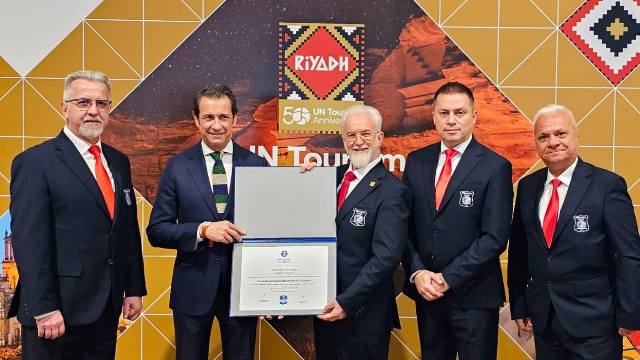
You first received this quality certificate about 10 years ago, as far as we know, but we saw that now in Riyadh, it was awarded to you again. What is it about and how can a university gain such recognition for quality?
Yes, exactly. We received it for the first time in 2016, and the path to it is not easy at all and the certificate is not given once and for all, but must be checked and renewed every three years. The first time is the most difficult, because it is a process that is carried out with the help of experts from the World Tourism Organization for Education. It covers everything from working conditions to educational staff and modern curricula, to cooperation with the business community in the given area.
After the adjustments and recommendations, a professor, an expert, from the UN Tourism Education Department, comes here to Skopje, to the university, who performs an evaluation, after which he prepares a report on whether you meet the criteria for receiving a quality certificate. So, it is a thorough check and verification.
After several successful extensions of this certificate, the latest one comes after in February this year, a representative of UN Tourism, Prof. Dr. Antonio Carles from Valencia and an international auditor for quality in higher education, was in Skopje for several days to evaluate the quality of the Faculty of Tourism at the University of Skopje. After the evaluation, Professor Carles stated that the University of Skopje is among the 100 best Faculties of Tourism in the world.
During his visit to the University of Skopje at that time and my conversations with him, Professor Carles expressed satisfaction with the high quality of the teaching and curricula at the other faculties of our university, an opinion that he also expressed publicly in interviews with several Macedonian media outlets.
By the way, on the sidelines of the General Assembly of the United Nations World Tourism Organization (UN Tourism), which was held in Riyadh, Saudi Arabia, the Director for Innovation, Education and Investment, Antonio Lopez de Avila, awarded me the quality certificate for the Faculty of Tourism at the University of Skopje for the next three years, and it is the result of the latest report by Professor Carles. So, the quality has been confirmed once again.
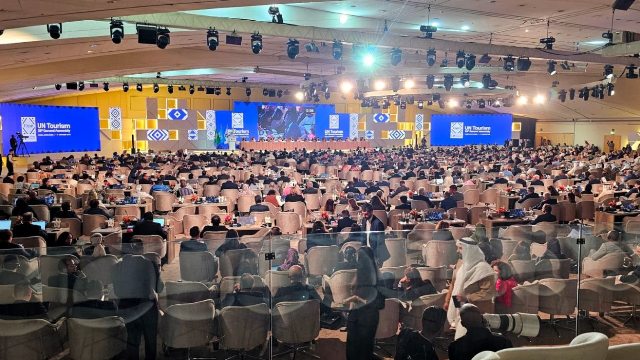
In addition to this ceremonial act and the meeting with Antonio Lopez da Villa, you also had meetings with other leaders of UN Tourism. What did you discuss, what would you highlight?
Ugh, a difficult question, there were many. However, first of all, I would highlight the meeting, on several occasions, with the new Secretary-General of UN Tourism, H.E. Shaika Al-Nowais, who takes office in January next year and will be the first woman to head this organization in its 50-year history. Her election was confirmed at the gathering in Riyadh. Congratulating her on the election, in the short conversation we talked about the planned visit to Madrid, of students from the University of Skopje, in January next year, and the possibility of visiting the UN Tourism headquarters in Madrid and being received by her. She expressed her readiness for such a visit.
For the same purpose, among other things, I also spoke with the Director of Associate Members, Ion Vilcu, who also gladly accepted the proposal. So, it is almost certain that in January, when the tourism fair in Madrid is held, our students will have the opportunity to visit the UN Tourism headquarters and meet with the leaders of this organization.
I also met with the current Secretary General of UN Tourism, H.E. Zurab Pololikashvili, who is completing his 8-year term this year and whom I have known since his election to that position.
Otherwise, if I were to list all the meetings now, there would not be so many pages in this magazine, but, for the delegation of the University of Skopje, this world gathering was an opportunity for more meetings with potential partners, companies and colleagues from universities and educational institutions from other countries. The main topics discussed were the possibilities for mutual cooperation and agreements for visiting the University of Skopje and Macedonia as an attractive tourist destination.
Finally, what are your impressions of Riyadh, Saudi Arabia, the organization of this global event and the hospitality of the Saudis?
Exceptionally good organization, to perfection. The Saudis are excellent hosts, hospitable, helpful, patient, smiling.
Hundreds of high-ranking delegations, thousands of attendees, and everything worked without problems. From the welcome at the airport in Riyadh, to the transfer to the hotel, information about what and where it is being held, the conduct of the conferences, panel discussions, socializing, and even sending them off to the airport, everything ran smoothly. An example of the organization of such a global gathering.
I would also like to highlight the gala dinner we attended, organized by the hosts, on the occasion of the opening of the General Assembly and the celebration of the 50th anniversary of UN Tourism, which was a real spectacle.
And Riyadh, which I am in for the first time, is a world-class modern city, with huge boulevards, a metro, representative buildings, luxury hotels, impeccably clean and tidy. At first glance, you can recognize an almost perfectly arranged metropolis
.All in all, I have only positive impressions from my overall stay, both at the elite UN Tourism gathering and in Saudi Arabia as a country.
Text: Economist: The World in 2026
 ЗАПОЗНАЈ СЕ СО ИСТОРИЈАТОТ